
If you own a home that was built before the 1980s and your drains have been giving you grief, the age of your property is probably a bigger factor than you realise. Sydney has a vast amount of older residential housing stock, from Federation-era terraces in the Inner West to post-war brick homes in the southern and western suburbs, and the underground drainage systems in these properties were installed with materials and methods that have now been in the ground for 50 to 100 years.
That does not mean the pipes are beyond help, but it does mean the problems you encounter tend to be different in nature to what newer homes experience, and understanding why makes it easier to deal with them properly rather than just treating the symptoms repeatedly.
Old Pipes Sydney: What They’re Made Of
Homes built from the early 1900s through to approximately the 1970s were typically plumbed with either clay or concrete pipes. Both materials were the standard of their time and genuinely durable over the short to medium term. The issue is not that these pipes were poorly made. They were never designed with a 100-year service life in mind, and the way they were joined creates specific vulnerabilities as they age.
Clay and concrete pipes are installed in sections that are fitted together at joints rather than being continuous runs of a single material. Over the decades, ground movement causes these joints to shift slightly. Tree roots, which are relentlessly efficient at finding moisture and nutrients, locate the fine gaps at these joints and push through. Once inside the pipe, a root system grows to fill the available space, catching grease, debris, and waste material until a blockage forms.
A clay pipe is also brittle. Soil movement, the weight of vehicle traffic on driveways, and the simple passage of time cause sections to crack. A cracked section allows soil ingress in addition to root intrusion, which accelerates the rate at which the interior profile of the pipe is reduced.
The Role of Sydney’s Tree Canopy
Sydney’s older suburbs are defined in large part by their established tree canopy. The fig trees, jacarandas, and liquidambars that shade the streets of Newtown, Leichhardt, Dulwich Hill, and dozens of similar suburbs are genuinely part of what makes those areas desirable to live in. They are also, from a drainage perspective, a persistent challenge.
Established trees have root systems that extend well beyond the drip line of the canopy above. In terrace-dense areas, these roots travel under footpaths, boundary lines, and through the drainage pipes that run beneath them. Council-maintained street trees are often the source of root intrusion in pipes that run near the kerb line or under the front of a property.
Root intrusion in a pipe does not fix itself. Left alone, it worsens steadily until a full blockage or structural pipe failure occurs. The pattern most homeowners experience is repeated partial blockages that respond to clearing but return within months. This is a reliable sign that the underlying pipe condition needs to be assessed rather than just the blockage cleared again.
Grease and Fixture Age in Older Kitchens
Older homes also tend to have kitchen drainage configurations that were designed for different household habits and detergent technologies than we use today. Blocked drains in older homes are commonly due to grease accumulation. While it’s a common problem across all housing types, it is particularly prevalent in homes where the drain runs are long, the pipe diameter is on the smaller side, and the pipe interior surface is rougher due to age and wear.
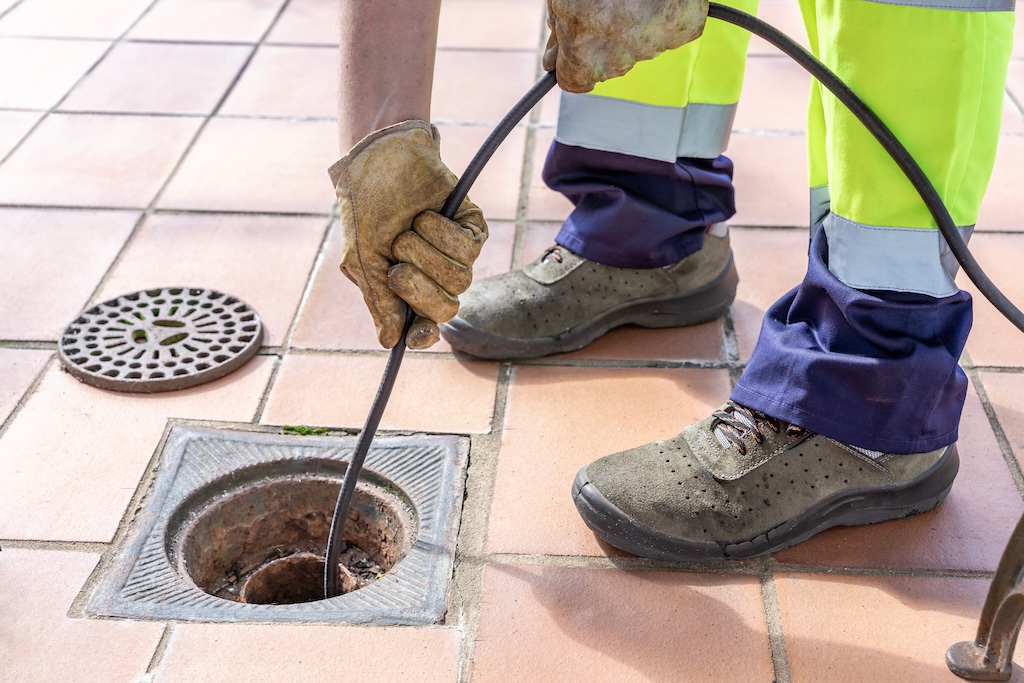
Grease enters the drain in liquid form when hot water is running, then cools and solidifies on the pipe wall as it travels through. Over time, these deposits build up and narrow the pipe’s internal diameter until flow is significantly restricted. High-pressure jetting is the most effective way to clear this kind of accumulation, and it is far more thorough than any chemical drain product available to homeowners.
What a Proper Assessment Involves
The most useful thing a terrace house plumbing problems homeowner can do when drainage problems become recurring is request a CCTV camera inspection before committing to any course of action. A camera fed through the drainage line shows clearly what is happening inside: whether a blockage is from grease, root intrusion, structural damage, or a combination. It also shows the extent and location of any pipe damage, which determines whether the repair needed is a simple clean, a relined section, or targeted excavation in a specific area.
Acting on that information properly is what prevents the same problem from returning every few months. Clearing a blockage in a pipe with significant root intrusion buys a few months of normal flow. Relining that section of pipe addresses the root intrusion permanently and restores full structural integrity without excavating your yard.
Drainage Services for Sydney’s Older Homes
Fast Response Plumbing works with Sydney homeowners across a wide range of property ages and drainage conditions. We carry out CCTV inspections, high-pressure drain clearing, and pipe relining for residential properties throughout the metropolitan area, including the Inner West, Northern Beaches, Western Sydney, Sutherland Shire, and the Macarthur region.
If your older home has drainage that keeps causing issues, a proper inspection is the most cost-effective starting point. We assess what is actually there, explain it clearly, and give you upfront pricing before any repair work begins. Contact Fast Response Plumbing to arrange an assessment.